Steel, Stainless Steel or Aluminum ? How to Choose the Right Metal for Furniture (Without Regrets)
Choosing a metal for furniture sounds like a simple decision.
Steel.
Stainless steel.
Aluminum.
Three materials. Three price tags. Three strong opinions. And yet, this single choice will decide:
whether your product feels solid or flimsy,
whether it survives outdoors or ages badly,
whether production is smooth or painful,
and whether your margin lives or dies.
In short: this is not a cosmetic decision. It’s an industrial one.
First things first: there is no “best” metal
Let’s kill the myth right away. There is no superior material. Only materials that are right for a specific context.
If someone tells you “aluminum is better” or “stainless steel is the only serious option”, they are skipping the most important question:
What does this product actually need to do?
Now let’s look at the three candidates — without marketing clichés.
Steel: strong, honest, and unforgiving if neglected
Steel is the backbone of furniture manufacturing. It’s everywhere — and for good reason.
Why steel works
Excellent mechanical strength
Very good rigidity
Predictable behavior
Cost-efficient
Easy to bend, weld and assemble
Steel is perfect for:
structural elements
chairs, tables, frames
indoor furniture
high-use environments
Steel doesn’t pretend. If something works in steel, it usually works well.
Steel’s weak spot: corrosion
Steel has a single enemy: time + humidity.
Left untreated, it will rust. Always. That’s why finishes are not optional. At O-FLEX³, especially for outdoor furniture, we usually recommend:
galvanizing steel before powder coating it
Why?
galvanization protects the metal itself,
powder coating protects the surface,
together, they dramatically increase lifespan.
Paint alone is not enough outdoors.
It looks fine — until it doesn’t.
Steel is reliable, but only if you respect it.
2. Stainless steel: resistant, exposed, expensive
Stainless steel enters the conversation when corrosion resistance and visual presence matter.
What stainless steel does well
Excellent resistance to humidity and oxidation
No need for paint for protection
High-end appearance
Long lifespan in aggressive environments
It’s often used for:
outdoor furniture
hospitality and public spaces
kitchens, bathrooms, marine environments
visible structural parts
The price of “clean”
Stainless steel is not just steel with better manners.
It is roughly 4× more expensive than regular steel
Welding is more complex
Finishing welds is time-consuming
Every defect is visible
Stainless steel doesn’t hide mistakes. It puts them under a spotlight. It’s a premium material — and it demands premium execution.
3. Aluminum: light, modern, but not magical
Aluminum is often chosen for one word: weight.
Why aluminum is attractive
Very light
Naturally corrosion-resistant
Ideal for outdoor use
Easier handling and transport
Clean, modern appearance
It’s well suited for:
outdoor furniture
large pieces that must remain movable
repeated production
extrusion-based designs
contract
The reality check
Aluminum is not a shortcut.
It is roughly 2× more expensive than steel
It is mechanically weaker
It requires thicker sections for rigidity
It deforms more easily
Welding is technical and unforgiving
A badly designed aluminum chair feels cheap. A well-designed one feels effortless. The difference is not aluminum itself — it’s engineering.
4. What actually matters when choosing a metaL
Forget trends. Focus on constraints.
Indoor or outdoor?
Indoor → steel is often the smartest choice
Outdoor → aluminum or stainless steel, or steel with proper protection
Structural loads?
High load → steel or stainless steel
Light use → aluminum, if well designed
Visual intent?
Painted, discreet → steel
Raw, visible metal → stainless steel
Light, minimal → aluminum
Series size?
Small series → steel is usually simpler
Large series → aluminum can become efficient
Limited premium runs → stainless steel
Budget reality?
Steel = lowest cost, finish-dependent
Aluminum = ~2× steel, lighter logistics
Stainless steel = ~4× steel, premium expectations
The classic mistake
The most common error is choosing a material too early.
Before defining:
use conditions
structural needs
finishing strategy
production volumes
Material choice should be the result of industrial reasoning, not a stylistic reflex.
How we approach it at O-FLEX³
At O-FLEX³, we never start with:
“Let’s use aluminum.” or “Stainless steel will look better.”
We start with:
how the object will be used
how it must behave
how it will be produced
how it must age
Only then do we choose the right material. Because in furniture, materials don’t fail. Decisions do.
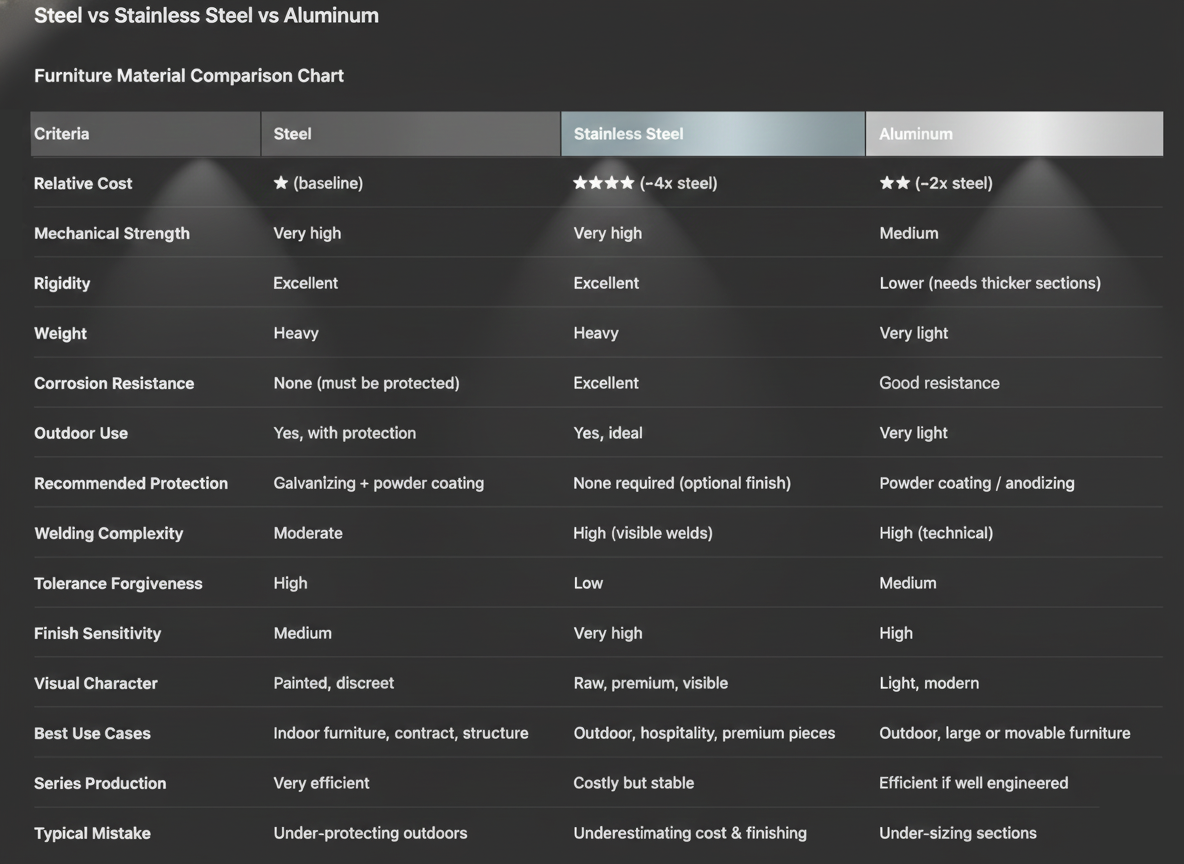
Summary of characteristics